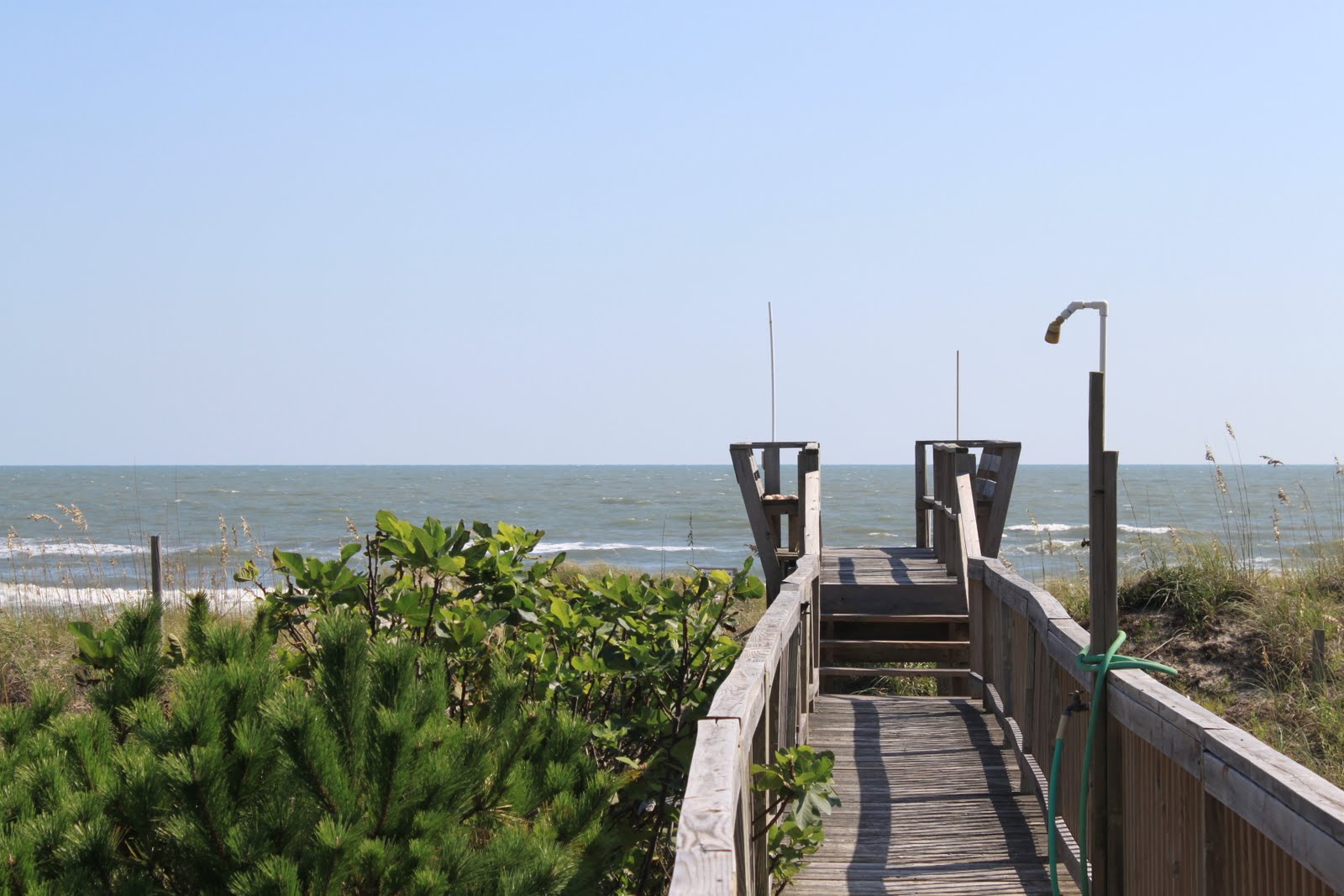
Last weekend, M and I hopped a red eye to North Carolina. Our final destination was on the beautiful southeast coast-Holden Beach, where a family beach house awaited our arrival.We were joined for the weekend by M's brother and sister-in-law, making for a great visit with some of our favorite people.
I have heard countless stories of Holden Beach over the past two years. It holds a very special place in M's heart as he grew up using the home with his family throughout his childhood. I heard about his grandfather, who would take off upon arrival, only to return an hour later to let M know where all of the cute girls his age were staying. I heard about jumping in the surf, riding bikes, exploring tide pools, searching for crabs at night and lots of family fun over the years.
It didn't take long for me to morph into a kid there myself, jumping in the surf, watching pods of dolphins swim by, waiting for sea turtles to hatch, taking long walks under a full moon, digging for shells. It was wonderful
M's brother and his lovely wife are expanding their family in the next few months, making this the last family trip that there won't be little teeny people running around. It's a bittersweet realization as we so enjoy their company and, in our selfishness, their undivided attention. But it's also a time of tremendous excitement as we consider the passing on of these great family traditions to the next generation. Our lives will be richer with these new kiddos to love (and spoil...and take on adventures...and learn from).
It was a quick trip-too quick. I can't wait to return to the cozy bungalow on Holden Beach. I feel like its always been part of my life even though I just discovered it.
Thursday, September 15, 2011
Friday, September 9, 2011
Travel and Camp on Durable Surfaces
After you've done your planning, made your calls to find out rules and regulations and actually made your way to the trail, there are some specific things you can do to make sure you Leave No Trace as you travel.
To be clear, you can practice these principles in the front country as well as the back country. You can be a responsible car camper just as easily as a responsible trekker. The principles of LNT have no borders and can be practices abroad, in hostels, national parks, even in your own backyard. It's a mentality that we leave a place better than we found it...that's not a bad idea to get behind, right?
- Established trails and campsites
- Rock
- Gravel
- Dry Grasses
- Pine needles
- Snow
(leafy vegetation, mosses and areas without a trail are NOT durable and should therefore be avoided)
* The idea here is that every step you make leaves a mark on the environment. Our footsteps can kill vegetation, destroy habitat, cause erosion and bisect previously untouched areas. We should look for ways to travel that will avoid these negative impacts and make it impossible for others to see where we've been.
Good campsites are found, not made
* While we were on our LNT trip, we disassembled numerous fire rings that had been built in previously pristine areas (the ones with all of the aluminum foil scraps were the worst!). Most wilderness areas will have established campsites and if they're available, you should use an area that's already been impacted than create a new impacted space. There's generally no reason to build new sites if you plan ahead but if you have to, find a site that offers the previously mentioned durable surfaces rather than meadow grasses.
Camp at least 200 feet away from water sources
* It can be terribly alluring to set up your tent on a riverbank but your presence will drive away wildlife as well as potentially contaminate waterways. It becomes extremely tempting to just wash that one dish in the lake or wash your hair in the creek (don't do either of these things by the way, even if you have biodegradable soaps). In addition, banks of waterways are fragile ecosystems and are easily eroded. As a short cut, 200 feet is about 70 adult steps. This is still quite close to the water you were hoping to enjoy but enough space to minimize your presence. In the event that a designated campsite has already been established by a park/nature area, it is better to use it than to create a new campsite but be particularly careful of your impact on the water.
- Make sure you use existing trails and campsites
- Walk in a single-file line and in the middle of the trail to reduce impact
To be clear, you can practice these principles in the front country as well as the back country. You can be a responsible car camper just as easily as a responsible trekker. The principles of LNT have no borders and can be practices abroad, in hostels, national parks, even in your own backyard. It's a mentality that we leave a place better than we found it...that's not a bad idea to get behind, right?
Travel and Camp on Durable Surfaces
What is a "durable" surface?- Established trails and campsites
- Rock
- Gravel
- Dry Grasses
- Pine needles
- Snow
(leafy vegetation, mosses and areas without a trail are NOT durable and should therefore be avoided)
* The idea here is that every step you make leaves a mark on the environment. Our footsteps can kill vegetation, destroy habitat, cause erosion and bisect previously untouched areas. We should look for ways to travel that will avoid these negative impacts and make it impossible for others to see where we've been.
I am durable
Good campsites are found, not made
* While we were on our LNT trip, we disassembled numerous fire rings that had been built in previously pristine areas (the ones with all of the aluminum foil scraps were the worst!). Most wilderness areas will have established campsites and if they're available, you should use an area that's already been impacted than create a new impacted space. There's generally no reason to build new sites if you plan ahead but if you have to, find a site that offers the previously mentioned durable surfaces rather than meadow grasses.
I am NOT durable
* It can be terribly alluring to set up your tent on a riverbank but your presence will drive away wildlife as well as potentially contaminate waterways. It becomes extremely tempting to just wash that one dish in the lake or wash your hair in the creek (don't do either of these things by the way, even if you have biodegradable soaps). In addition, banks of waterways are fragile ecosystems and are easily eroded. As a short cut, 200 feet is about 70 adult steps. This is still quite close to the water you were hoping to enjoy but enough space to minimize your presence. In the event that a designated campsite has already been established by a park/nature area, it is better to use it than to create a new campsite but be particularly careful of your impact on the water.
A durable trail system
In Popular Areas:- Make sure you use existing trails and campsites
- Walk in a single-file line and in the middle of the trail to reduce impact
(Don't walk around muddy areas. Plan ahead, wear your boots and gaiters and plow right through them. If everyone walks around the mud hole, it creates a 10' trail where there need only be a 1' path.)
- Keep campsites small and concentrate your activity where impact already exists and where vegetation does not.
I am durable
In Pristine Areas:
- Disperse your group to avoid creating a trail.
If everyone walks next to one another rather than single file, you will be able to look behind you and see no trace of your paths.
- Avoid places where impact is new
I am durable as sand but WAY too close to the water and therefore NOT durable
In summary, let me acknowledge that choosing to be a steward of our wild places means committing to altering your experience. We all want to stay in the most beautiful places and experience the feeling of being the first one to see or touch a place, particularly as our wilderness areas become fewer and farther between. It's time we all commit to the greater good here in keeping those places wild so that we can enjoy them for a very long time. It will never ruin your experience to camp at an established site, just change it a bit. Take a hike to a pristine area rather than camping in one...it will be worth it in the long run.
Wednesday, September 7, 2011
Plan Ahead and Prepare
I'm not reinventing the wheel here. Over the next week or so, I'm going to put up some information on how you...yes, YOU...can be an awesome back country steward. As you should know, if you've been following the last few posts, I recently returned from taking my Leave No Trace Master Educator course with NOLS and the Leave No Trace Center for Outdoor Ethics. What would be the point of taking such a great course and learning so much, if I didn't share it?!
For more information please visit: www.lnt.org
All of the principles to follow are designed to equip all of us to be responsible outdoors men and women. We've all had at least one outdoor experience that could have been improved if the person before us had picked up their trash (I've found whole loaves of bread and entire onions left on stumps) or the ones at the campsite next door would quiet down. So, without further adieu, I give you:
A few specific suggestions:
* Know the regulations and special concerns for the area you'll visit
- On a raft trip, you can pee in the water. In the woods, you should use the soil rather than a stream. Many rules cannot be considered blanket rules. There are just too many variables. Call ahead and find out the rules for the area you'll be in. Not only will you be taking better care of our wild lands but you might save yourself a ticket too.
* Prepare for extreme weather, hazards and emergencies
- As my mother said, "It's better to have it and not need it, than to need it and not have it." An example here might be the forethought to pack your trowel (or lady supplies) for a day hike so you don't just poop...or worse... randomly in the woods (EW. seriously, people- don't do this. Bury it). Also, having good gear really can reduce our impact on the environment. Think camp stove vs camp fire- a huge difference in impact.
* Schedule your trip to avoid times of high use
-Give areas a chance to recover from high use seasons rather than contributing to beating them into oblivion. It'll be better anyway when you don't see anyone for days.
* Visit in small groups. Split larger parties into groups of 4-6
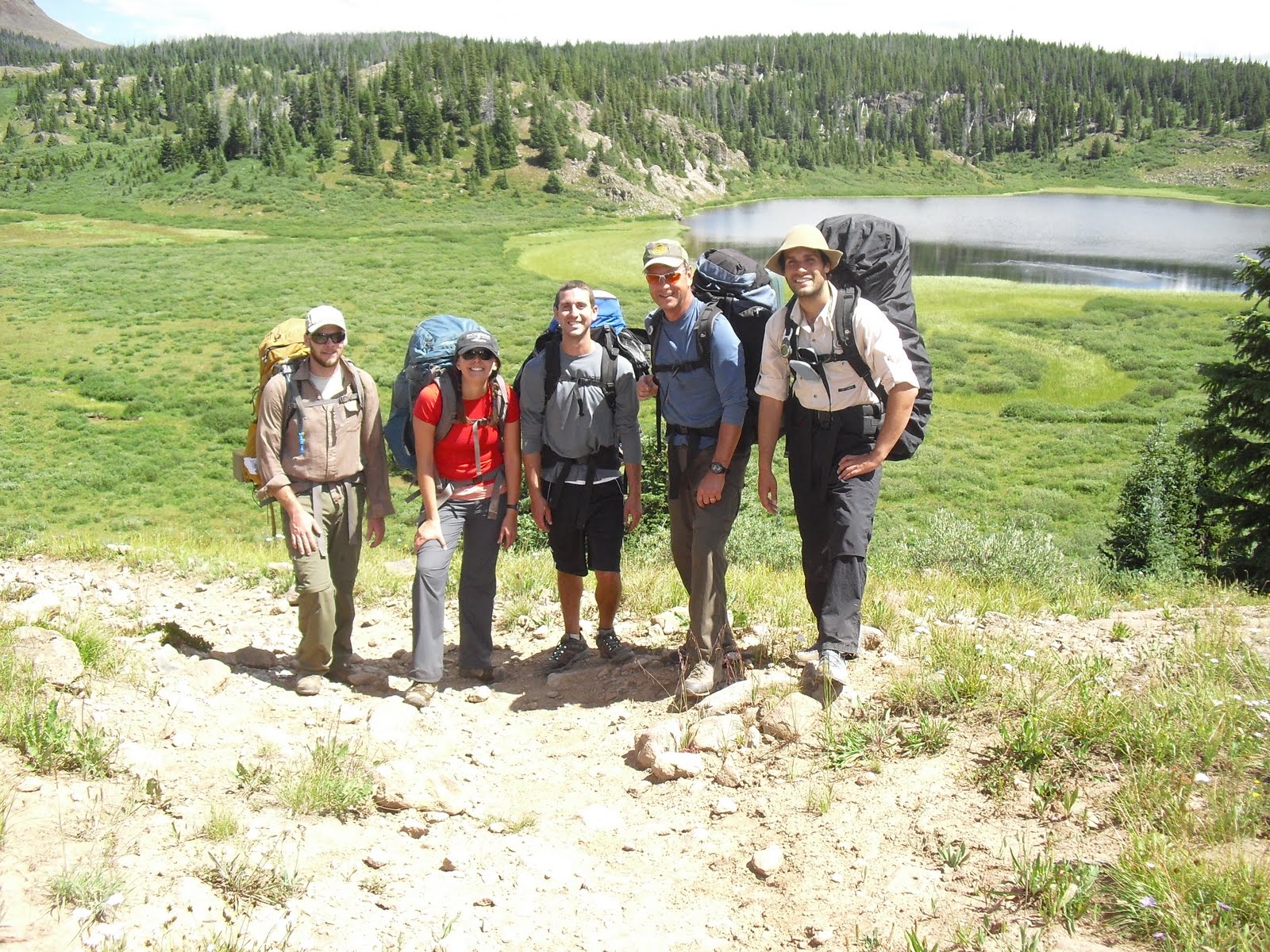
- Some places, like the Boundary Waters, require this. Others don't but it's still a good practice. Again, this avoids too much use on an area at one time. It's also (in my opinion) a better way to get to know you hiking companions when the group is small. You can plan to meet up for meals or breaks as you backpack but walk in smaller groups. You will also give yourself a better shot at seeing wildlife without so much chatting (right, chicks?). ha. Here's a pic of our small hiking group in the Flat Tops.
* Repackage food to minimize waste
- Ditch the cardboard and bulk bags. Carefully measure out how much food you need for your trip and repackage it into 1-2 lb portions. It's easier to divide weight this way. Repackaging means less weight to carry and less mess (we've all seen wet cardboard...it's tempting to ditch it...get rid of it in advance instead)
* Use a map and compass to eliminate the use of rock cairns, flagging, or marking paint
- Again, this is called Leave NO Trace. Even marking your path with sticks is altering an area and it's better to leave what you find, the way you find it. More on that later.
For more information please visit: www.lnt.org
All of the principles to follow are designed to equip all of us to be responsible outdoors men and women. We've all had at least one outdoor experience that could have been improved if the person before us had picked up their trash (I've found whole loaves of bread and entire onions left on stumps) or the ones at the campsite next door would quiet down. So, without further adieu, I give you:
Principle 1: Plan Ahead and Prepare
I don't think I could argue that any one principle is more important that another but if you don't plan ahead, you could find yourself in a position to reduce the quality of an area, just because you didn't think to ask the questions.A few specific suggestions:
* Know the regulations and special concerns for the area you'll visit
- On a raft trip, you can pee in the water. In the woods, you should use the soil rather than a stream. Many rules cannot be considered blanket rules. There are just too many variables. Call ahead and find out the rules for the area you'll be in. Not only will you be taking better care of our wild lands but you might save yourself a ticket too.
* Prepare for extreme weather, hazards and emergencies
- As my mother said, "It's better to have it and not need it, than to need it and not have it." An example here might be the forethought to pack your trowel (or lady supplies) for a day hike so you don't just poop...or worse... randomly in the woods (EW. seriously, people- don't do this. Bury it). Also, having good gear really can reduce our impact on the environment. Think camp stove vs camp fire- a huge difference in impact.
* Schedule your trip to avoid times of high use
-Give areas a chance to recover from high use seasons rather than contributing to beating them into oblivion. It'll be better anyway when you don't see anyone for days.
* Visit in small groups. Split larger parties into groups of 4-6
- Some places, like the Boundary Waters, require this. Others don't but it's still a good practice. Again, this avoids too much use on an area at one time. It's also (in my opinion) a better way to get to know you hiking companions when the group is small. You can plan to meet up for meals or breaks as you backpack but walk in smaller groups. You will also give yourself a better shot at seeing wildlife without so much chatting (right, chicks?). ha. Here's a pic of our small hiking group in the Flat Tops.
* Repackage food to minimize waste
- Ditch the cardboard and bulk bags. Carefully measure out how much food you need for your trip and repackage it into 1-2 lb portions. It's easier to divide weight this way. Repackaging means less weight to carry and less mess (we've all seen wet cardboard...it's tempting to ditch it...get rid of it in advance instead)
* Use a map and compass to eliminate the use of rock cairns, flagging, or marking paint
- Again, this is called Leave NO Trace. Even marking your path with sticks is altering an area and it's better to leave what you find, the way you find it. More on that later.
Friday, September 2, 2011
Checking Out the Flat Tops (not the Arsenio kind)
I've been back for a week already...I don't know where time goes sometimes. Sheesh.
My trip to the Flat Tops Wilderness Area near Dotsero, CO was incredible. The curriculum only planned on us hiking 10 miles over the 3 1/2 days we were on trail (we spent another 2 in the White Owl Ranger Station as our "classroom"). The group was comprised of seasoned outdoorsmen/women and by lunch on the first day we had hiked in 2 hours what it had taken last year's group to do in 5. It was promptly decided that we'd blow past our first planned campsite to hike deeper into the wilderness and instead of 10 miles, we logged 30. 22 miles or so as a team, in packs and another 8 for me in our free time day hikes/excursions. Not bad. Not bad at all.
The group of 11 ended up being made up of 3 women and 8 men. There were a lot of state parks and forest service representatives, trail volunteers and a few outdoor educators. Then there was me...the weirdo who takes these courses more or less for the fun of it....so I can blog about it. ha.
I'm going to be detailing more of the educational component in the next few blogs...including my "tampon talk" but for now, I'll leave you with a slide show that one of my new friends in Colombia has assembled. Enjoy your first look at the Flat Tops Wilderness Area .
Saturday, August 20, 2011
My Kind Of Higher Education
I'm off this week for some skill development and resume boosting adventure! Through the National Outdoor Leadership School, I will spend the next week camping, hiking, meeting new friends and earning my Leave No Trace Master Educator Certificate.
According to their website, which is much more articulate than I, the Leave No Trace Center for Outdoor Ethics is an educational, nonprofit organization dedicated to the responsible enjoyment and active stewardship of the outdoors by all people, worldwide. Leave No Trace partners with travel companies, businesses, schools etc to spread the word about the best ways we can reduce our impact in the outdoors. They do a tremendous amount of education and outreach so if any of you are interested in learning more (or teaching it to others), visit the website for endless resources.
As part of this specific course, each participant will be required to give a 10-20 minute lesson to the group on one of the core principles of LNT. Always freakishly committed to teaching more men about women in the outdoors, I requested to go off book to teach about LNT principles specific to women. And wouldn't you know it...there's only one other woman taking the course. Look out guys, we're going to have all kinds of awesome conversations about pee funnels and tampons in my lesson plan! :)
Tomorrow afternoon, I'll drive about 3 1/2 hours to reach our meet point, in the Flat Tops Wilderness area. We will learn as we hike on moderate terrain at elevations between 9,00 and 11,00 feet. There will be alpine lakes, groves of aspen, spruce and fir, vast meadows and mountain ranges all around. I. Am. Stoked!
There's nothing like quite like learning about the outdoors in the outdoors.
Saturday, August 13, 2011
The Tinder Experiment
I have heard for years about various fire starting tools that one can add to their 10 essentials kit. In the event of an emergency, the ability to make a fire can also mean health and safety. While I'm not sure if it's ever really been studied, I would imagine that if you find yourself in dire straights, having a fire can ease your nerves and provide a level of emotional comfort as well as physical.
Last week, M and I hiked out for a night of camping. I brought with me a couple of empty film canisters filled with things I had heard made great fire starter. I had a brand new Light My Fire Fire Steel. I didn't take a picture of mine, so here's what I'm talking about:
The Fire Steel is ONLY your spark. It will not ignite, which is why you need a tinder, such as the Vaseline cotton balls or dryer lint options. All of these options are lightweight, easily packed and ready to go when needed.Earlier, I noted that the fire steel was new. This is important because it took a minute or two to make it spark as you need to get through the outer coating.
Has anyone else tried the dryer lint and had better luck? Mine might have too much dog hair in it to be useful.
Last week, M and I hiked out for a night of camping. I brought with me a couple of empty film canisters filled with things I had heard made great fire starter. I had a brand new Light My Fire Fire Steel. I didn't take a picture of mine, so here's what I'm talking about:
I also took some dryer lint as its highly flammable and a tissue smeared in Vaseline.I would have preferred a few cotton balls in Vaseline but we were all out...so we made use of what we did have.
Here's what we're starting with. Our teepee fire.
By the way-yes, that's a giant lighter. We had to have backup in case none of these great ideas paid off.
My photographer (M) apologizes for the blurry photos to follow. I think you'll still get the idea.
Prepping the tissue in vaseline
Tissue is ready to go on one side of our fire
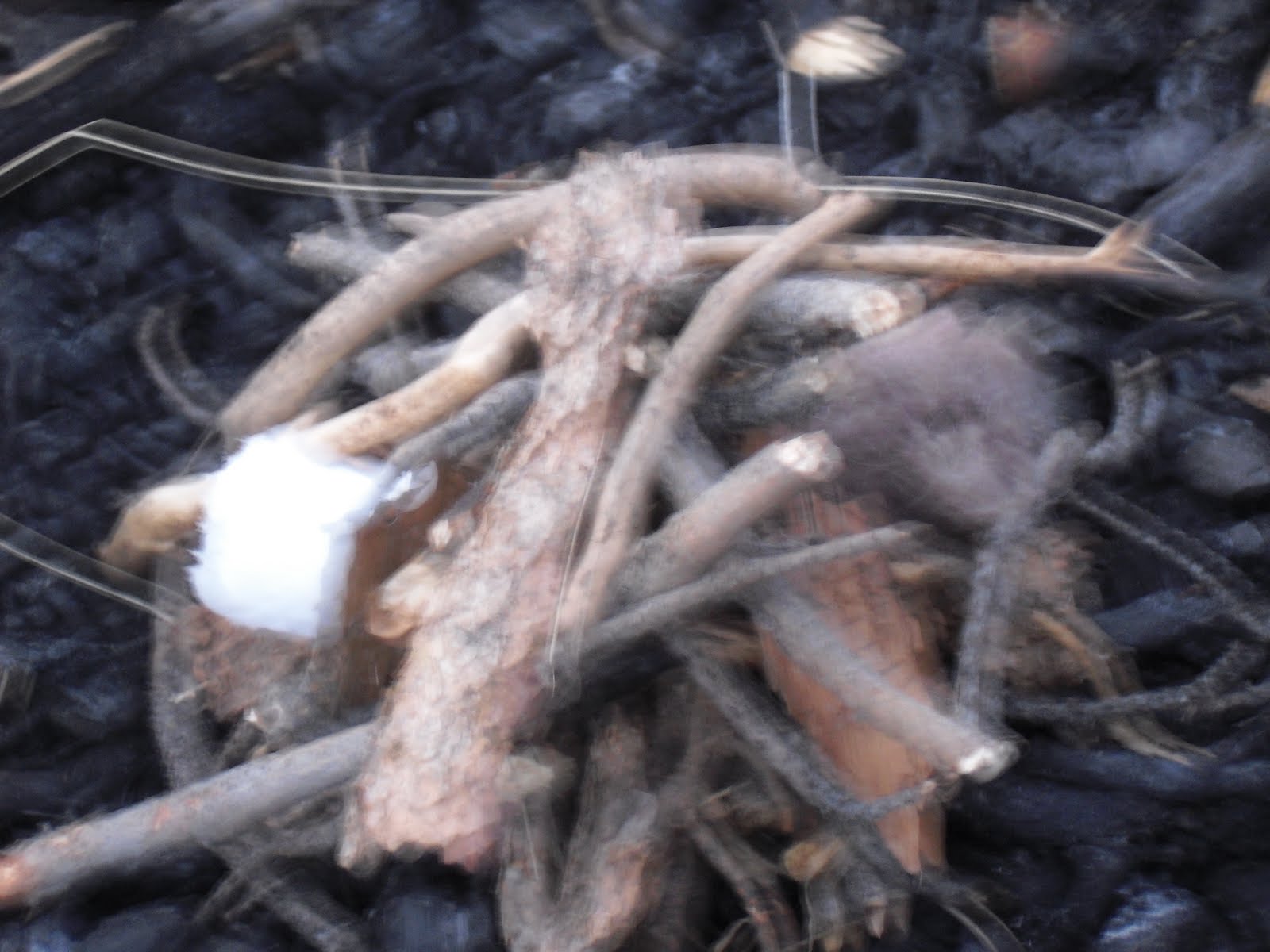
Tissue on the left. Wad of dryer lint on the right (it looks like a blurry gray mass)
Pulling out the Fire Steel to light my fire
Once both sides were lit. The tissue is winning by a mile!
And we're off!
Bracco approves of our cozy campfire.
So do we!
So, while the dryer lint surely did burn, it was more of a slow smoldering burn. I found this a bit difficult to work with it trying to light other twigs etc. The tissue burned long and strong. In hindsight, I shouldn't be too surprised that a petroleum product burned so well. Now I'm curious to know whether a tissue, paper towel, cotton ball or other paper will burn better in vaseline. I guess that will be my next experiment.
I kind of like the idea of bringing a small container of vaseline without having it pre-made into a cotton ball fire starter. It makes it more versatile for other possible needs on trail. Also, I'm a big proponent of having at least two different ways to make fire if needed, particularly for extended trips. So, if you're headed out bring a spare lighter or weather-resistant (proof) matches along as well as your fire steel.
As a side note, let me just list the difference between a magnesium fire starter and the fire steel. A magnesium strip looks like this:
You can sort of see in the picture that first you shave a small pile of the magnesium from the "shaving edge." You then use a pocket knife to strike the "sparking edge" in order to light the little pile of magnesium you just made. The magnesium bar does not burn whole and is waterproof. The filings burn hot and fast so it's necessary to have additional tinder easily accessible or your fire will quickly burn out. The more shavings you've put in your pile, the longer the burn BUT it takes a decent effort to get this built up.The Fire Steel is ONLY your spark. It will not ignite, which is why you need a tinder, such as the Vaseline cotton balls or dryer lint options. All of these options are lightweight, easily packed and ready to go when needed.Earlier, I noted that the fire steel was new. This is important because it took a minute or two to make it spark as you need to get through the outer coating.
Has anyone else tried the dryer lint and had better luck? Mine might have too much dog hair in it to be useful.
Thursday, August 11, 2011
Adventures Revealed
The fall lineup includes:
Tour de Fat- Labor Day Weekend (a tradition of course)
Holden Beach, NC
Fort Collins Sustainable Living Fair
Paonia, CO
Depoe Bay, OR
San Jose, CA
Minneapolis, MN
Omaha, NE
A visit from my awesome bro and sis-in-law (hopefully)
Complete 5th Peak and climb at least one 14er this fall
A secret weekend away that I cannot reveal at this time as it's a surprise
AND a longer adventure yet to be determined
When I look at this all written out, I'm a little overwhelmed. I mean, that's 5 states in addition to my own and all of these trips will occur between now and the end of November...most are just a weekend. A couple are work-related but I plan to attempt some outdoor fun while traveling for those trips too. Upon completeion, I plan to settle in for a looooong winter's nap.
Tour de Fat- Labor Day Weekend (a tradition of course)
Holden Beach, NC
Fort Collins Sustainable Living Fair
Paonia, CO
Depoe Bay, OR
San Jose, CA
Minneapolis, MN
Omaha, NE
A visit from my awesome bro and sis-in-law (hopefully)
Complete 5th Peak and climb at least one 14er this fall
A secret weekend away that I cannot reveal at this time as it's a surprise
AND a longer adventure yet to be determined
My week-long TBD will either involve technical mountaineering south of the border
OR
backpacking in some European country
I'm waiting to see if the mountaineering will pan out (they haven't reached the minimum to run the trip yet). If not, M and I are buying the cheapest ticket available to run away together for a while. Either way, I have no complaints and plenty of new gear to try out!
When I look at this all written out, I'm a little overwhelmed. I mean, that's 5 states in addition to my own and all of these trips will occur between now and the end of November...most are just a weekend. A couple are work-related but I plan to attempt some outdoor fun while traveling for those trips too. Upon completeion, I plan to settle in for a looooong winter's nap.
What are you up to this fall?
Subscribe to:
Posts (Atom)